

Roofing Insurance Supplement Automation: What Xactimate Doesn’t Fix
Xactimate gives you the tool to price a supplement. It doesn’t catch every missed line item, chase the adjuster who’s gone quiet, or answer the phone during a post-storm call surge. Here’s what actually closes that gap — and what should stay with your estimator.
Quick Answer
Roofing insurance supplement automation uses an AI-driven system — not just estimating software — to assemble the claim file from crew photos and measurements, compare the adjuster’s scope against the actual roof condition to catch missed line items, follow up with carriers on a set cadence, and answer storm-surge calls 24/7. It runs alongside the estimating software and CRM you already use, not instead of them.
Who This Guide Is For
- Roofing company owners and claims coordinators
- Crews evaluating supplements or estimating tools
- Contractors leaving money unclaimed after storms
- Teams overwhelmed by post-storm call volume
Key Takeaways
Xactimate still prices the job — the system catches what’s missing and chases carrier approval.
Scope disputes and carrier escalations stay with your team.
The system connects to AccuLynx, JobNimbus, Roofr, QuickBooks, and Xactimate instead of replacing them.
Missed line items, slow carrier follow-up, or storm-call overflow determine what gets built first.
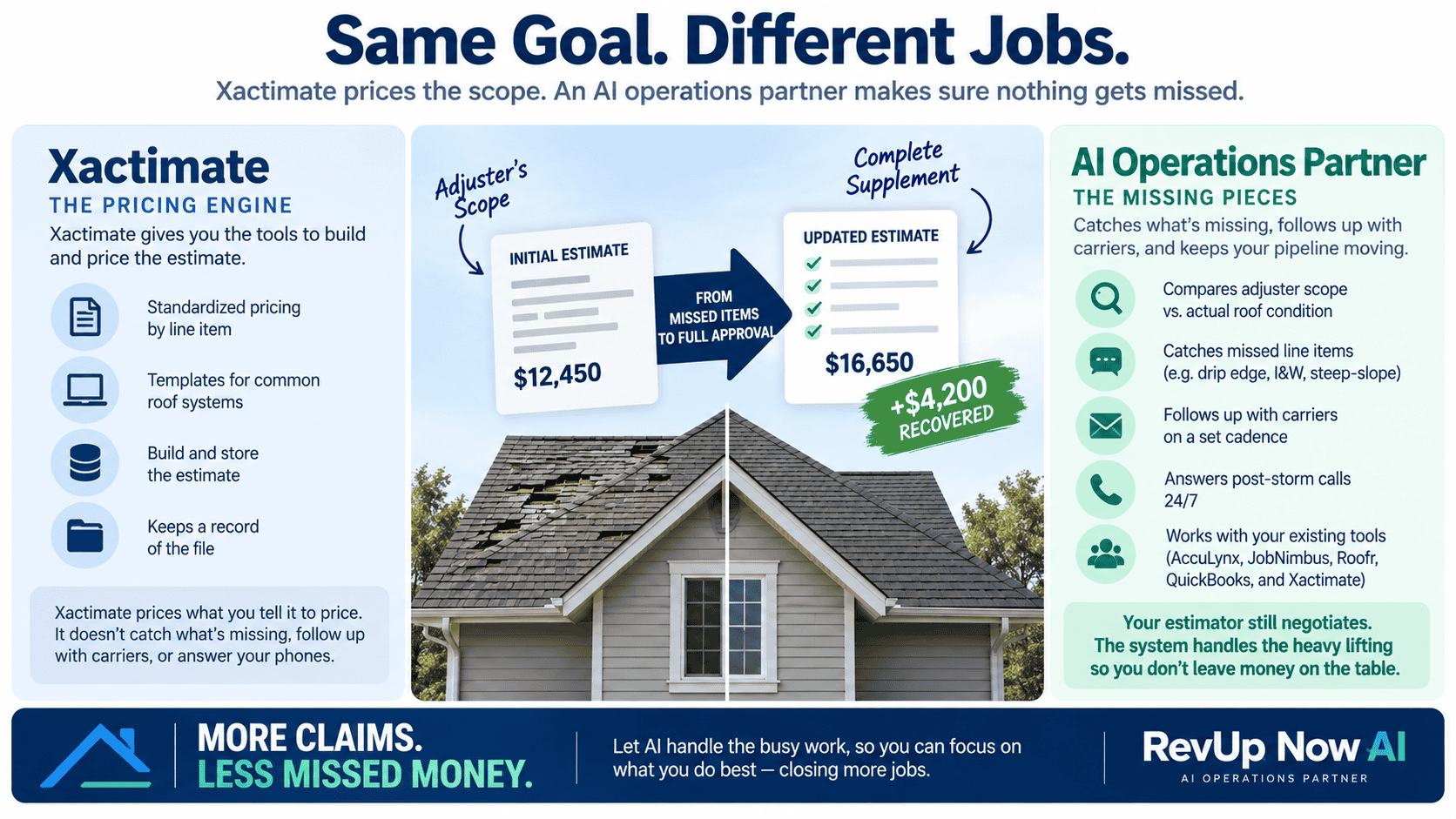
A hailstorm rolls through on a Tuesday. By Friday, forty roofs need inspections, and the phone hasn’t stopped ringing since Wednesday morning. An adjuster’s scope comes back on one job missing drip edge, ice-and-water shield, and the steep-slope charge — about $4,200 left on the table. Nobody catches it because the estimator is three inspections behind and the supplement never gets filed.
That’s not an estimating problem. Xactimate priced the job correctly for the scope. It’s a capture-and-follow-through problem — and it’s why roofing companies with solid estimating software still leave real money unclaimed after every storm.
What Xactimate Actually Gives You
Search for roofing supplement help and you’ll eventually land on Xactimate, the estimating software most carriers and contractors already use, or roofing-specific platforms like AccuLynx, JobNimbus, and Roofr. They’re the industry standard, and if you don’t have one, get one. They give you:
- A standardized way to price labor and materials by line item
- A place to build and store the estimate
- Templates for common roof systems and components
- A record of the file in case a dispute comes up later
What they don’t do is compare the adjuster’s actual scope against your inspection notes to catch what’s missing, follow up with the carrier when a submitted supplement goes quiet, or answer the phone when forty people are calling after the same storm. That work still depends on an estimator with time to do it — usually the same one, already three inspections behind.
The Part Software Was Never Built to Solve
Every roofing company that’s worked a storm season runs into the same wall: the software prices what you tell it to price — it doesn’t catch what you forgot to tell it. Four gaps show up over and over.
Line items are easy to overlook under pressure. Drip edge, ice-and-water shield, steep-slope charges, and code-required upgrades get left off scopes when an estimator is moving fast through a storm queue.
Adjuster scopes don’t always match the roof. A carrier’s initial scope is based on what the adjuster saw and priced — if it’s short, someone has to build the case for the difference, backed by photos and code citations.
Supplements go quiet in a carrier’s queue. A filed supplement isn’t an approved supplement. Without a follow-up cadence, it sits until someone remembers to call.
Storm-surge calls overwhelm the front office. A hailstorm can turn a normal week of calls into a month’s worth in three days, and inspections fall behind while the phone keeps ringing.
- Scope disputes requiring negotiation with the adjuster
- Complex code-compliance arguments
- Customer relationship management on delayed claims
- Final pricing and markup decisions
The Other Fix Crews Try: Hire More, or Outsource to a Supplementing Company
Most roofing companies solve this one of two ways before they solve it for good.
Hire a full-time claims coordinator. It works until storm season hits, and one person can’t keep up with forty simultaneous claims plus the phone.
Outsource to a third-party supplementing company. Common in the industry, and it can recover missed line items — but most charge a percentage of every supplement they write, and they still don’t answer your phones or chase approvals on the rest of your operation.
Both fixes patch the symptom. Neither one closes the loop from inspection to a fully paid claim.
What an AI Operations Partner Does Instead
Xactimate gives you a pricing engine. A third-party supplementing service gives you a person who checks scopes for a cut of every claim. An AI operations partner catches missed line items, chases carrier approval, and answers the storm surge — inside the tools you already use, for a flat fee instead of a percentage of every claim.
| Estimating Software (Xactimate) | Third-Party Supplementing Service | AI Operations Partner | |
|---|---|---|---|
| Compares adjuster scope to actual roof condition | No | Yes | Yes |
| Chases carrier/adjuster approval automatically | No | Sometimes | Yes |
| Answers storm-surge calls 24/7 | No | No | Yes |
| Assembles claim file from field photos automatically | No | Manual | Yes |
| Works inside your existing estimating/CRM tools | N/A | Sometimes | Yes |
| Pricing model | Software license | Percentage of every claim | Flat fee |
| Requires staff to operate day-to-day | Yes | Partially | No |
One caveat worth being direct about: the storm-call answering piece is one part of this, not the whole thing. Some roofing companies need supplemental recovery; money’s being left on the table on jobs already scoped. Others have that under control but lose inspections to unanswered calls during the surge. The build reflects wherever the money’s actually leaking.
How RevUp Now AI Builds the System
Consult
A working session on where claims leak — missed line items, slow carrier follow-up, or call overflow during storm surges.
Build
The system is built around your inspection process and regional code requirements and is connected to AccuLynx, JobNimbus, Roofr, or Xactimate.
Implement
A supervised go-live, usually starting with one crew or one storm event, with test runs reviewed before full rollout.
Maintain
Ongoing monitoring on a flat monthly retainer — adjusting rules and catching the next bottleneck.
Pricing is flat: one build fee, one monthly retainer, no per-claim charges, and no contract lock-in. Most crews have something live in about 30 days. Learn more about the broader RevUp Now AI process.
Supplement Checklist: Line Items Adjusters Miss Most
Whether a person or a system is checking the scope, these are the line items that go missing most often:
- Drip edge and gutter apron
- Ice-and-water shield, especially in valleys and at eaves
- Starter shingles as a distinct line item, not bundled into waste
- Steep-slope or high-pitch labor charges
- Code-required upgrades, which vary by jurisdiction
- Decking replacement for rotted or damaged sheathing found during the tear-off
- Permit and disposal fees
- Ridge cap and ridge ventilation components
A missing item here isn’t just a pricing gap — it’s money that comes directly out of margin because nobody flagged the difference before the job closed out.
Common Myths About Supplement Automation
Myth: AI decides what the carrier should pay
Not in this model. The system flags discrepancies against the roof condition; your estimator builds the case.
Myth: You have to switch estimating software
The system is built to work alongside Xactimate, AccuLynx, JobNimbus, and Roofr.
Myth: Adjusters push back harder on an automated supplement
They’re reviewing your documentation and code citations, not the process that assembled them.
Myth: Only large roofing companies benefit
Fit is about whether claims go unfiled or unchased — not company size.
Related RevUp Now AI Resources
Ready to Stop Leaving Money on the Roof?
See how RevUp Now AI can catch missed line items, chase carrier approval, and handle the storm-call surge — inside the estimating and CRM tools you already use.
Talk With RevUp Now AIFrequently Asked Questions
Does this replace Xactimate or our estimating software?
No. It’s built to work alongside Xactimate, AccuLynx, JobNimbus, and Roofr, not replace them.
How does it know what line items are missing?
It compares the adjuster’s scope against your inspection photos, measurements, and regional code requirements to flag discrepancies.
What happens with a disputed scope?
It routes to your estimator for negotiation. The system handles comparison and documentation, not the carrier conversation.
Will this help specifically during storm season?
Yes — it’s built to handle call surges and claim volume spikes without adding seasonal staff.
What happens to claim data and photos?
They route into your existing project management or CRM software, encrypted, with no manual re-entry step.
We’re a small crew — is this overkill?
If supplements have ever gone unfiled or unchased because nobody had time, the fit is about that gap, not company size.