

Same-Day Estimates: How Electrical Contractors Automate Proposals Without Losing Margin
Electrical bid automation solves a problem most contractors don’t realize has two sides. Slow estimates lose the bid to a faster competitor. But rushed estimates lose the job’s profit after you’ve already won it. Most electrical companies are optimizing for the wrong half of that trade-off.
Quick Answer
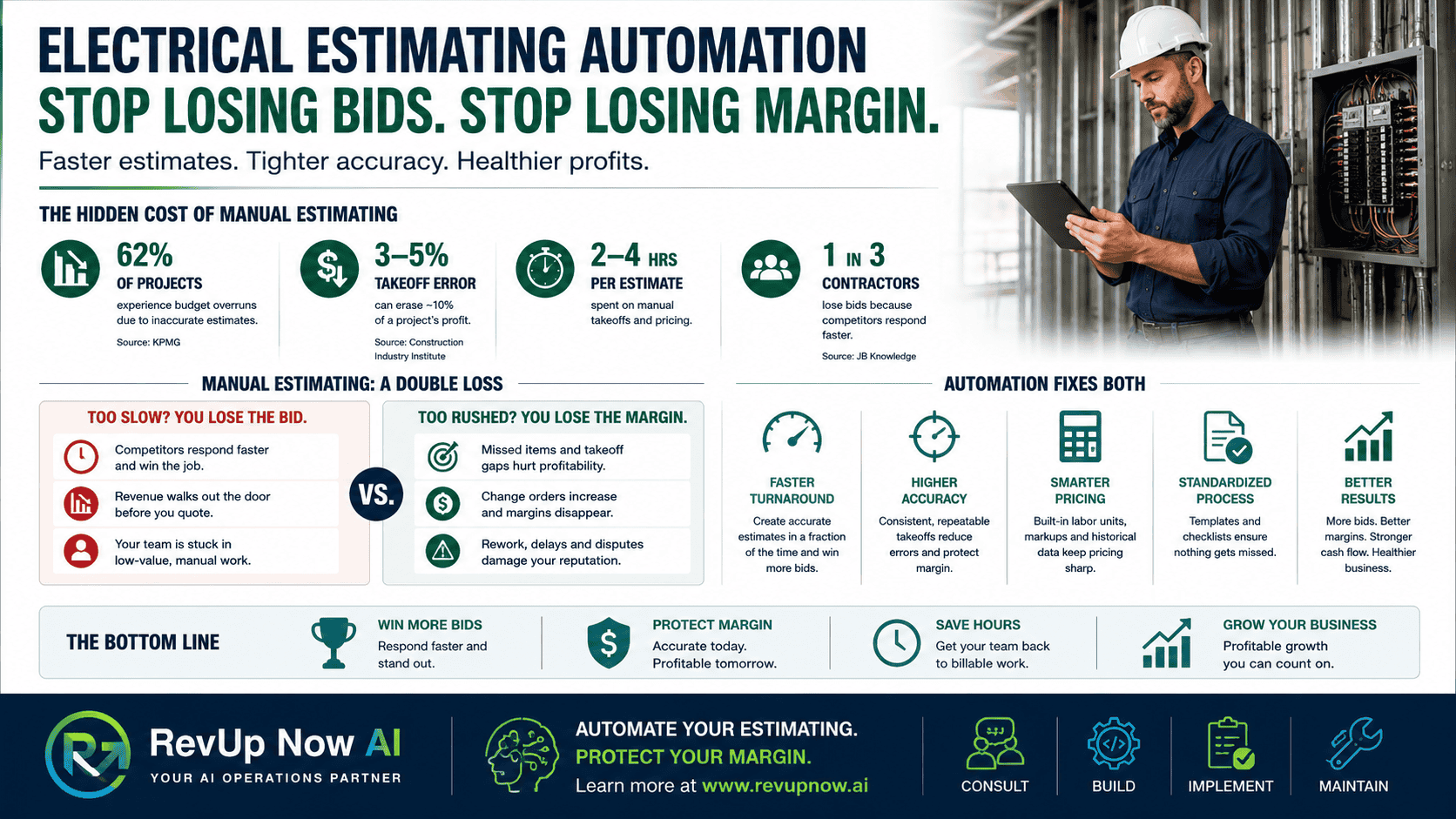
Electrical contractors lose margin two ways with manual estimating: slow turnaround loses bids to faster competitors, and rushed or incomplete takeoffs quietly erase profit after the job is won. Electrical bid automation speeds up takeoff and pricing while enforcing the same accuracy checks every time, so faster doesn’t mean sloppier.
Who This Guide Is For
Electrical contractors and estimators who feel caught between sending bids fast enough to win them and building them carefully enough to protect margin once the job starts.
Key Takeaways
Inaccurate estimates are linked to a large share of project financial failures industry-wide, not just occasional bad luck.
A takeoff error of just 3-5% can erase roughly 10% of a project’s profit once labor and overhead are factored in.
Rushed, last-minute estimates measurably increase error rates, not just anecdotally.
It’s not about estimating faster at the cost of accuracy. It’s about removing the manual steps where errors get introduced in the first place.
This guide breaks down why manual estimating puts you in that bind, what it’s actually costing you, and how it connects to how RevUp Now AI automates back-office work for electrical contractors.
Why Slow Estimates Cost You the Bid
A general contractor or homeowner rarely waits around for the perfect bid. They collect two or three quotes and move forward with whoever gets back to them first with a number they trust. Every extra day your estimate takes is a day a competitor’s faster, and sometimes worse, proposal is sitting in the decision-maker’s inbox instead of yours. Speed alone doesn’t win the job, but being slow guarantees you’re competing from behind before the customer has even opened your file.
Why Fast Estimates Can Cost You Even More
Here’s the trap: the obvious fix for slow estimates — rushing them — creates a worse problem. A missed disconnect, an uncounted circuit, or an incomplete conduit run looks small on paper, but these gaps compound quietly across a project.
| Takeoff Error Size | Approximate Profit Impact | On a $500K Project |
|---|---|---|
| 1-2% omission | Minor margin drag | A few thousand dollars |
| 3-5% omission | ~10% profit loss | $25,000-$50,000 erased |
| Rushed, last-minute bid | Up to 30% higher error rate | Compounds across every line item |
A 5% material takeoff error on a $500,000 commercial electrical project can erase $25,000-$50,000 in expected margin before a single panel is installed. And it isn’t just takeoff errors: copper and wire pricing fluctuates constantly, and estimators pricing off last quarter’s supplier sheet are eroding margin on jobs they think are already profitable.
Why This Keeps Happening
Most electrical contractors don’t lose margin because the field work is bad. They lose it because the estimating process is disconnected: takeoffs done manually against static plans, pricing pulled from a spreadsheet nobody’s updated in weeks, and labor units that vary depending on who happened to build the bid.
- Manual takeoffs make it easy to miscount plan symbols, especially under deadline pressure.
- Stale pricing sheets lock in material costs that don’t reflect current copper and wire prices.
- Inconsistent labor assumptions mean two estimators can price the same job differently, with no way to know which one is right.
Why Even Good Electrical Contractors Lose 3 Out of 4 Bids
If your win rate feels low, it might not be a sign anything’s wrong. The industry average bid win rate for electrical estimators sits between 18% and 25%. That means the typical contractor spends real time and money preparing bids and walks away empty-handed on three out of every four attempts. For smaller firms bidding commercial and public-sector work, that ratio can fall even further, to roughly one win in every ten or eleven submissions.
Above 40% win rate: you’re likely underpricing the work, which creates a different margin problem entirely.
Price competitiveness alone rarely explains the losses. Incomplete scope documentation, poor proposal presentation, and slow response times erode apparent competitiveness even when the number itself is fair. Industry research indicates that quality presentation and clear scope documentation alone — a proper narrative and exclusions list instead of a bare number — can improve win rates by 20-30%. That’s before touching pricing at all.
Residential vs. Commercial vs. Industrial: Where the Risk Changes
Estimating risk doesn’t look the same across every type of electrical work. Knowing which category a job falls into changes what you should be watching for.
| Project Type | Target Win Rate | Where Risk Concentrates |
|---|---|---|
| Residential | 25-35% | High volume, narrow per-job margin, fast turnaround expected |
| Commercial | 15-25% | Complex systems (lighting controls, backup generators, data cabling), tighter competition |
| Industrial | Lower, highly variable | High-voltage systems and hazardous-location wiring, where a single mistake can cost hundreds of thousands |
Calculate Your Own Bid Win Rate
Bid Win Rate = Jobs Won ÷ Bids Submitted × 100
Pull your numbers from last quarter before assuming the problem is estimating speed. If you’re well below the target range for your project type, the fix might be proposal quality or bid selection, not just turnaround time. If you’re well above it, check your margins before celebrating.
What Electrical Bid Automation Actually Looks Like
This is where RevUp Now AI’s electrical bid automation works differently from estimating software you buy and configure yourself. We build the automation around your pricing, your labor units, and your existing tools, then we run it.
- Digital takeoff support that counts plan symbols and auto-populates your bill of materials, cutting manual transcription errors.
- Material pricing tied to live supplier data instead of a spreadsheet that’s already out of date.
- Standardized labor units applied consistently, regardless of which estimator built the bid.
- A structured review flag before anything goes out, so speed never comes at the cost of a second set of eyes.
How RevUp Now AI Builds This
Consult (Week 1)
We map your current estimating process, pricing sources, and labor units to find exactly where time and accuracy are being lost.
Build (Weeks 1–3)
We build the takeoff and pricing automation around your existing tools and standards. You review test estimates before anything goes live.
Implement (Week 4)
We launch carefully and walk your estimating team through exactly what changes and what doesn’t.
Maintain (Every Month After)
We keep pricing data current, tune the system, and look for the next bottleneck worth fixing.
This is the same consult-build-implement-maintain process RevUp Now AI uses across every build. Flat fee, month-to-month retainer after go-live, no lock-in.
Ready to Stop Losing Bids or Margin?
Get your estimating process automated end-to-end. Flat fee, live in about 30 days, no dashboard to babysit.
Book My Operations AuditFinal Takeaway
Speed and accuracy in estimating aren’t actually competing goals — they only feel that way when the process is manual. Electrical bid automation lets you send a bid same-day without gambling the job’s margin to get there.
Frequently Asked Questions
Why do electrical contractors lose bids even when their work is good?
Losing bids is rarely about field quality. It usually comes down to slow turnaround, incomplete scope documentation, or inconsistent pricing that makes proposals look less competitive than the actual work justifies.
How much can a small takeoff error actually cost?
A takeoff omission of just 3-5% can erase roughly 10% of a project’s profit once labor and overhead compounding are factored in. On a $500,000 commercial project, that can mean $25,000-$50,000 in lost margin.
Does estimating faster mean sacrificing accuracy?
Not when the process is automated. Manual rushing increases errors because steps get skipped under time pressure. Automated takeoff and live pricing remove the manual steps entirely, so speed doesn’t require cutting corners.
Why does copper and wire pricing matter for estimating accuracy?
Material pricing fluctuates regularly, and estimators pricing off outdated supplier sheets can lock in numbers that don’t reflect current costs, eroding margin on jobs that looked profitable when bid.
What is a good bid win rate for electrical contractors?
Industry benchmarks suggest targeting 25-35% for residential work and 15-25% for commercial electrical projects. Below 15% typically signals a structural problem in estimating or bid selection, while above 40% often means the work is underpriced.
How much can better proposal presentation improve win rate?
Industry research indicates that quality presentation and clear scope documentation, rather than price alone, can improve win rates by 20-30%. A bid with a proper scope narrative and exclusions list often beats a similarly priced but poorly organized competitor.
What’s the difference between markup and margin in electrical estimating?
A 25% markup is not the same as a 25% margin. Conflating the two is one of the most common and costly electrical estimating mistakes, and it quietly erodes profit even when the bid looks correct on paper.
What does RevUp Now AI’s electrical bid automation actually replace?
It replaces the manual, error-prone steps: takeoff counting, stale pricing lookups, and inconsistent labor assumptions, not the estimator’s judgment on scope, risk, or client relationships.