

Why HVAC Jobs Sit Unbilled for Days — and What It Is Actually Costing You
HVAC dispatch-to-invoice automation closes the gap between a completed job and a paid invoice. For many HVAC companies, that gap is where cash quietly disappears — not because of poor service, but because paperwork, closeout, and billing lag behind the actual work.
Quick Answer
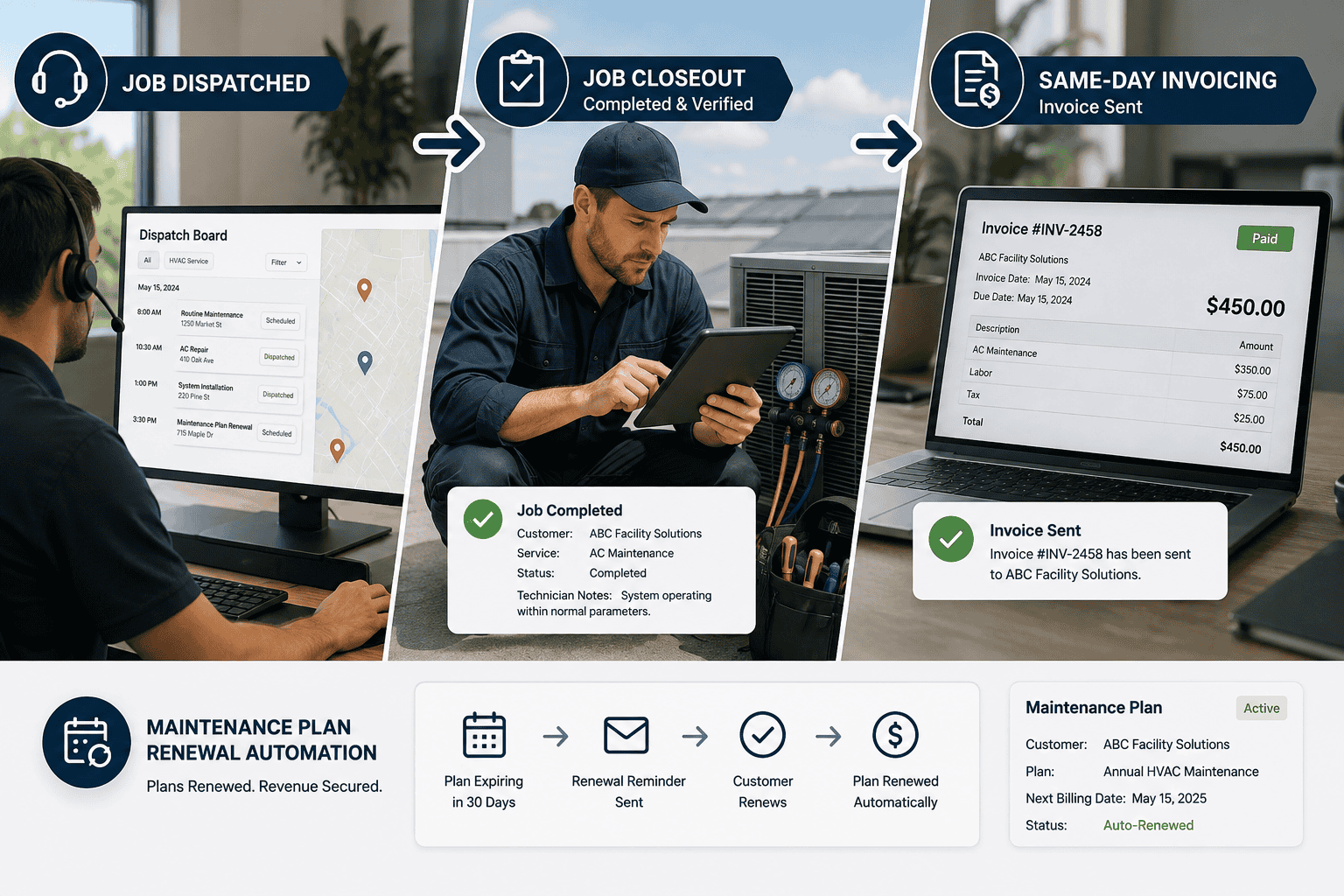
HVAC dispatch-to-invoice automation closes out jobs and moves approved work into invoicing the same day instead of days or weeks later. It can also keep maintenance-plan renewals on schedule. With a done-for-you model, RevUp Now AI builds, runs, and monitors the workflow so the HVAC owner isn’t left managing another dashboard.
Who This Guide Is For
HVAC owners, operations leaders, dispatch managers, and office teams dealing with slow closeout, billing backlogs, and inconsistent renewal follow-up.
- The problem: completed HVAC jobs remain unclosed or unbilled because information moves slowly between technicians, dispatch, office staff, and accounting.
- The cost: delayed cash flow, administrative backlog, missed follow-up, and maintenance plans that quietly lapse.
- The fix: connect job completion, closeout, invoicing, and renewal follow-up into one managed workflow.
- The outcome: fewer manual handoffs and a shorter path from completed work to collected revenue.
Key Takeaways
A slow dispatch-to-invoice cycle is usually a workflow-timing problem, not simply a staffing problem.
Every extra manual handoff increases the chance that closeout, billing, or renewal follow-up will be delayed.
Field-service software may provide the tools, but someone still has to configure, monitor, and maintain the process.
Done-for-you automation is designed to remove the recurring task instead of adding another system for the team to manage.
What Is the Real Cost of a Slow Dispatch-to-Invoice Cycle?
Three problems tend to appear when dispatch closeout and invoicing lag behind the actual work.
Where the Backlog Shows Up
- Cash gets stuck. Every day between job completion and invoice delivery is another day that earned revenue remains outside the business.
- Maintenance plans lapse quietly. A customer may not intend to leave. The renewal can still be lost because nobody followed up at the right time.
- The office becomes more reactive. Calls, scheduling changes, missing job notes, billing questions, and renewal tasks all compete for the same limited attention.
How Does Invoice Delay Affect When an HVAC Company Gets Paid?
The delay begins before the invoice reaches the customer. A technician finishes the work, but the office may still be waiting for job notes, equipment details, labor entries, photos, parts, approvals, or pricing confirmation. Each incomplete field creates another follow-up step.
The Delay Compounds
- Same-day closeout: the job record is completed while the details are still fresh.
- End-of-week billing: several jobs are reviewed and corrected in a batch, creating a queue.
- Late or incomplete closeout: the office must chase missing details before it can confidently issue the invoice.
HVAC late payments are not always caused by unwilling customers. In many cases, the business simply started the payment clock later than it needed to.
Why Doesn’t Better HVAC Software Fix the Problem by Itself?
Search for HVAC dispatch or invoicing software and you’ll find tools offering mobile invoicing, automated reminders, scheduling, and digital job forms. Those capabilities can help, but the software still needs an operating system around it.
Someone has to decide when a job is considered complete, which fields are required, what happens when information is missing, how invoices are approved, when customers are contacted, and how exceptions are handled. Someone also has to maintain integrations and troubleshoot the workflow when systems stop syncing correctly.
What Does Done-for-You Dispatch-to-Invoice Automation Look Like?
This is where RevUp Now AI works differently from a tool that the HVAC company must purchase and manage alone. The workflow is built around the company’s services, pricing, CRM, field-service platform, accounting process, and existing team responsibilities.
What Can Be Automated
- Completed jobs can trigger a closeout workflow immediately.
- Missing job information can be flagged before the invoice reaches accounting.
- Approved jobs can move into invoice generation without waiting for a weekly batch.
- Maintenance plans can be tracked so renewal outreach starts before expiration.
- Exceptions can be routed to the right team member instead of disappearing into a general queue.
- RevUp Now AI can monitor the workflow, adjust rules, and help keep the system running.
The goal is simple: remove a recurring operational burden rather than give the team another piece of software to babysit.
How Is an HVAC Dispatch-to-Invoice Workflow Built?
Consult (Week 1)
We map the dispatch, job-completion, billing, and renewal process to identify delays, duplicate work, and missing handoffs.
Build (Weeks 1–3)
We build the workflow around the systems and rules already used by the HVAC business, then test common and exception scenarios.
Implement (Around Week 4)
We launch carefully, confirm that the workflow behaves as expected, and explain the new process to the team in plain language.
Maintain (Ongoing)
We monitor performance, tune the workflow, address exceptions, and look for the next operational bottleneck worth removing.
This follows the same Consult, Build, Implement, and Maintain process RevUp Now AI uses across its operational automation work. The exact launch timeline depends on the systems involved, integration access, workflow complexity, and the speed of discovery and approvals.
How Does RevUp Now AI Fit Into an HVAC Operation?
RevUp Now AI is an AI Operations Partner for service businesses. It is not positioned as only an AI intake company or as a software vendor that hands over a dashboard and walks away.
The company consults, builds, implements, and maintains AI-powered operational workflows across the business. For an HVAC company, the starting point may be HVAC call handling and workflow automation, dispatch closeout, invoicing, renewal follow-up, or another repetitive task that is consuming staff time and slowing growth.
Related RevUp Now AI Resources
Ready to Stop the Billing Backlog?
Bring RevUp Now AI the operational task that keeps getting delayed. We will map the workflow, build the system, implement it, and help maintain it.
Talk to RevUp Now AIFinal Takeaway
A slow dispatch-to-invoice cycle is not a minor inconvenience. It is completed work waiting to become billable revenue, maintenance plans waiting for follow-up, and office staff spending time chasing information that should move automatically.
The answer is not necessarily another tool or another hire. It is a connected workflow built around how the HVAC company already operates, with clear rules for job completion, closeout, invoicing, exceptions, and follow-up.
Frequently Asked Questions
What exactly do I get with dispatch-to-invoice automation?
You get a workflow built around a defined operational outcome: moving completed HVAC jobs through closeout and into invoicing with fewer manual handoffs and delays.
Do I need to buy a separate audit first?
No. Workflow assessment is part of the Consult phase. RevUp Now AI maps the current process before building the automation.
Do I have to manage or learn new software?
The goal is to reduce management burden. RevUp Now AI builds around the tools already in use where feasible and can help monitor and maintain the workflow.
Does this replace office staff?
No. It is designed to reduce repetitive queues, follow-up work, and administrative backlog so staff can focus on customers, exceptions, and decisions that require judgment.
Does it work with the field-service software we already use?
In many cases, yes. Compatibility depends on the platforms, available integrations, account access, and the specific workflow being automated.
How quickly should an HVAC job be invoiced after completion?
The ideal target is the same day whenever the required job information and approvals are available.
How does pricing work?
Pricing depends on scope, system complexity, integrations, volume, and ongoing maintenance requirements. Contact RevUp Now AI for an assessment based on the actual workflow.
How long does implementation take?
Timing depends on workflow complexity and system access. A first version may be targeted for roughly 30 days, but that is a planning target rather than a guarantee.