
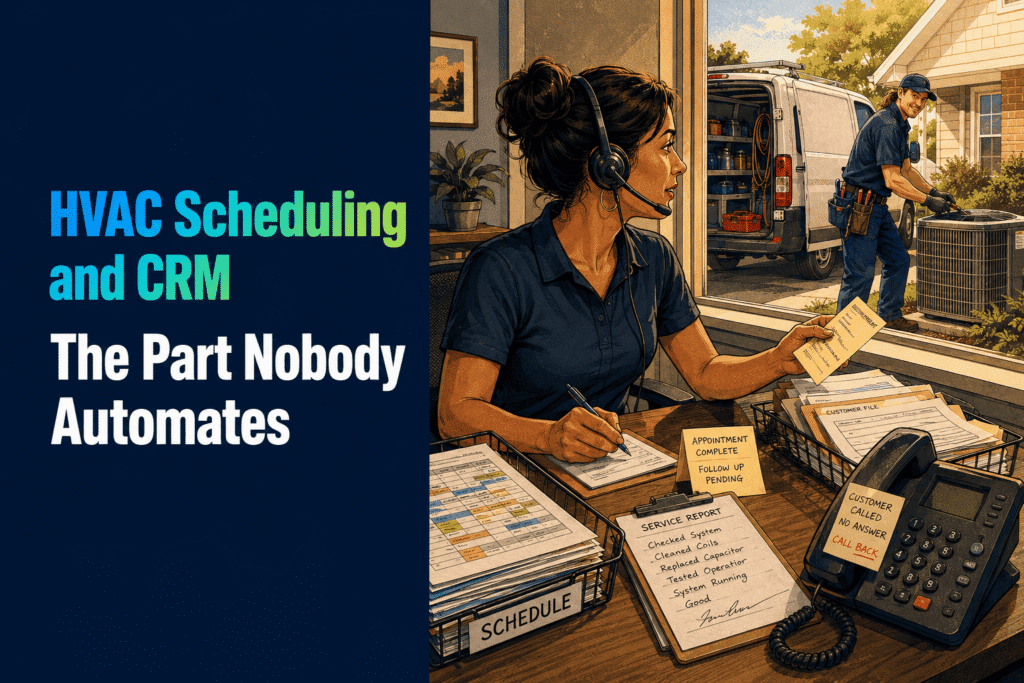
HVAC Scheduling and CRM: The Part Nobody Automates
Most HVAC shops have solved dispatch. The truck rolls, the job gets logged, the invoice goes out. What’s still sitting on a whiteboard or buried in a spreadsheet is everything that happens before and after that job — the follow-up call that never gets made, the maintenance plan that quietly lapses, the estimate nobody rebooked. That’s the gap this post is about.
Quick Answer
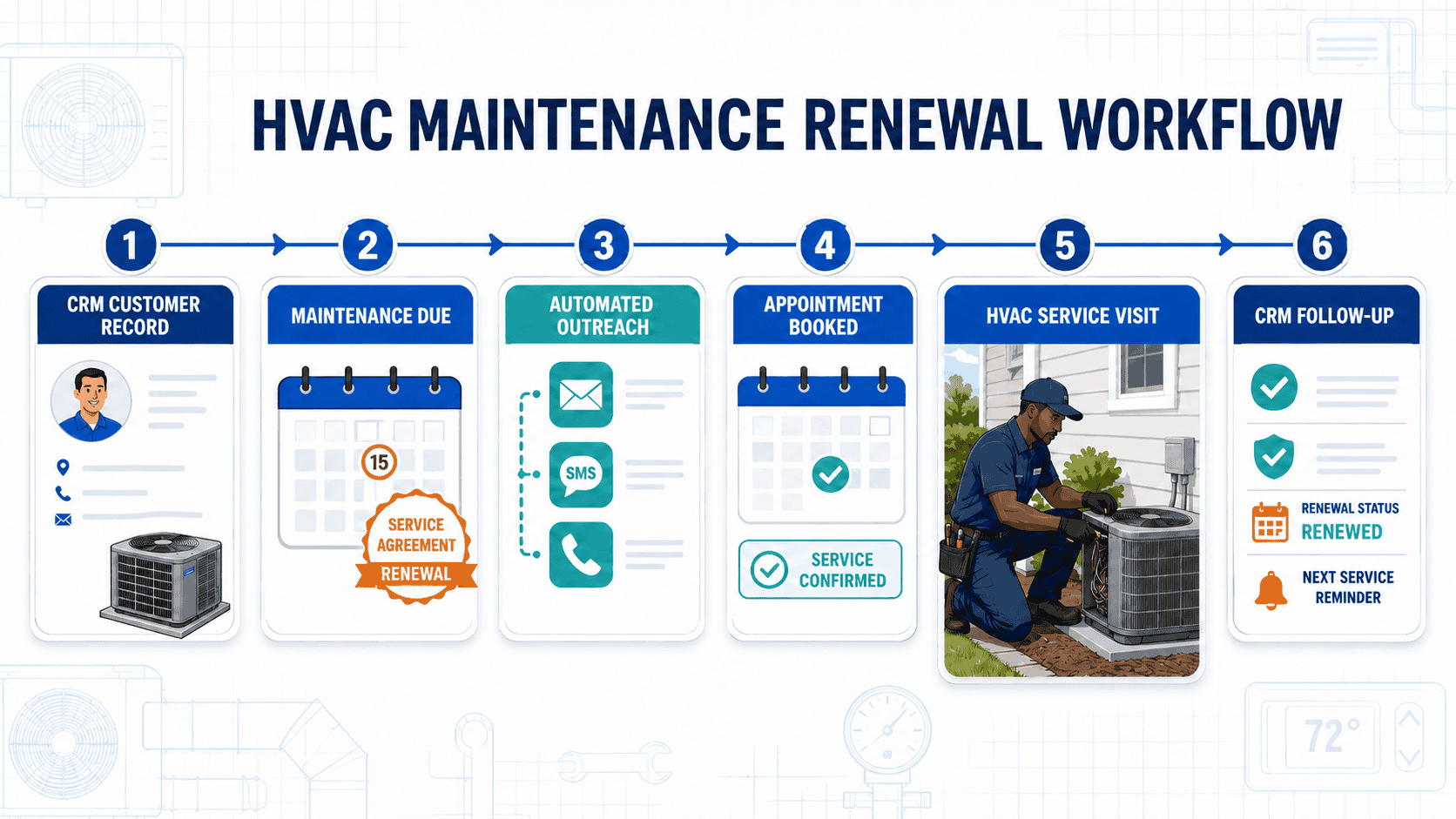
HVAC scheduling and CRM tools (Housecall Pro, ServiceTitan, and similar platforms) are good at getting a technician to today’s job. They’re not built to chase the customer relationship in between jobs — renewals, seasonal reminders, unbooked estimates, and no-show follow-up. That’s manual work most shops don’t have time for, and it’s where a done-for-you system earns its keep.
Who This Is For
HVAC business owners and office managers who already run a scheduling or field service tool, but still lose maintenance renewals, forget seasonal tune-up outreach, and let quoted jobs go cold because nobody has time to follow up by hand.
In This Article
The Problem HVAC Software Already Solved
To be fair to the software category, dispatch and scheduling tools have gotten genuinely good. A technician can see today’s route on a phone, a dispatcher can drag a job to a different slot when a no-show opens a window, and a customer gets a text when the truck is fifteen minutes out. That part of the business runs smoother than it did ten years ago, and most shops that adopted one of these platforms would not go back.
We covered how that same efficiency can extend all the way through to invoicing in an earlier piece — read HVAC Dispatch-to-Invoice Automation if you haven’t already. That post is about the job itself: getting from “truck is dispatched” to “invoice is paid” without anything falling through in the middle.
This post is about what happens outside that job. Because for most HVAC shops, the job itself isn’t where the revenue leaks. It’s everything around it.
The Real Gap: What Happens Between Jobs
Ask a shop owner what their scheduling software does, and they’ll describe dispatch, routing, maybe invoicing. Ask them what happens to a customer six months after an install, or what happens to the person who got a quote for a new furnace and never called back, and the answer is usually some version of “someone’s supposed to follow up on that.”
“Someone” is doing a dozen other things. That’s not a discipline problem — it’s a bandwidth problem. A CRM field for “next maintenance due” is only useful if someone checks it, and that person is also answering the phone, dispatching today’s jobs, and trying to get quotes out before the end of the day.
The parts that consistently fall through:
- Maintenance plan renewals. The plan is in the system. Nobody’s watching the renewal date until the customer calls someone else instead.
- Seasonal push outreach. Spring AC tune-ups and fall furnace checks are the easiest revenue in the business, and they require someone actually to reach out before the customer needs an emergency call.
- Unbooked estimates. A quote sits for two weeks with no follow-up, and the homeowner books with whoever calls back first.
- No-show and reschedule follow-up. A missed appointment should trigger an immediate rebook attempt. Usually, it just triggers a note in a field nobody reopens.
- Technician availability sync. When a same-day cancellation opens a slot, getting a waitlisted customer into it usually depends on someone remembering the waitlist exists.
What This Actually Costs a Shop
Maintenance plan renewals and seasonal tune-ups are usually the highest-margin work an HVAC company does — no emergency premium, no long diagnostic, often a routine visit that leads to a filter or part sale. Losing them isn’t a missed nice-to-have. It’s losing the best-margin revenue in the business to a competitor who happened to call first.
The same logic applies to unbooked estimates. A homeowner who requested a quote is already sold on the need for the work — they’re comparing who follows up, not whether to buy. A shop that responds in an hour wins jobs; a shop that responds in three days loses. And the software sitting on the estimate doesn’t change who responds faster.
None of this shows up as a line item anywhere. It shows up as slower growth, a maintenance plan that shrinks instead of compounds, and a team that feels busy every day while the business plateaus.
Scheduling Software vs. a Done-For-You System
| What You Need | HVAC Scheduling/CRM Software | RevUp Now AI (Done-For-You) |
|---|---|---|
| Getting a tech to today’s job | Yes — this is the core strength | We build around your existing tool, don’t replace it |
| Tracking renewal dates | A field exists in the system | We build the outreach that actually fires on it |
| Following up on unbooked quotes | Manual — someone has to remember | We build the follow-up sequence and staff who’s watching it |
| Seasonal tune-up campaigns | Possible with add-on marketing tools and more logins | One system we build, implement, and run for you |
| Who configures and maintains it | You — dashboards, workflows, integrations | Us — ongoing, as part of the retainer |
| What happens after setup | You’re on your own with the tool | We keep improving it as your business changes |
How RevUp Now AI Approaches This
We don’t sell HVAC shops a new scheduling platform, and we’re not asking anyone to rip out ServiceTitan or Housecall Pro. Those tools are doing their job. What we build is the layer that watches the gaps those tools leave open — and we build it around what your shop specifically loses the most revenue to, not a generic package.
Walk through your actual renewal, quote, and follow-up process to find where revenue is realistically leaking.
Build the specific automation — renewal outreach, quote follow-up, waitlist fill, whatever the audit turns up — around your existing tools.
Connect it to the scheduling and CRM system you already use — no new dashboard for your team to learn.
We run it, watch it, and adjust it as your service area, staff, or offerings change.
“Isn’t This Just Another AI Tool?”
Fair question — the HVAC software market is full of “AI” add-ons that turn out to be one more login nobody uses. Here’s how this is different.
“It’s another dashboard to manage”
There’s no dashboard for your team. We build the workflow, connect it to what you already use, and run it. Your office manager doesn’t log into anything new.
“We’ll set it up once, and it’ll drift”
We maintain it every month as part of the retainer — it’s not a one-time build we hand off and disappear from.
“AI receptionist” or “AI CRM” — same thing?
No. A virtual receptionist or CRM automation is one example of what we might build. The actual system depends entirely on where your shop’s revenue is actually leaking — renewals, quotes, dispatch, or something else.
“This is just for big franchises”
Flat build fee, flat monthly retainer, month-to-month. Built for the size of the shop, actually losing renewals to a whiteboard, not enterprise accounts.
Let’s Find Out What Your Shop Is Actually Losing
A short conversation is usually enough to spot where renewals, quotes, or follow-ups are falling through the cracks. See what that looks like for your business.
Talk to Us About Your HVAC BusinessFAQ
Do I need to replace my current HVAC scheduling software?
No. We build around Housecall Pro, ServiceTitan, or whatever you’re already running. The goal is to close the gaps that software leaves open, not replace tools that already work.
What’s the difference between this and an “AI CRM” add-on?
An add-on is still something your team has to configure and check. We consult on your specific gaps, then build, implement, and maintain the automation ourselves — it’s a service, not a tool you manage.
How fast can this actually catch a lapsed maintenance renewal?
That depends on how we build it during the consult — but the point is it no longer depends on someone remembering to check a field between calls.
Does this work for a small HVAC shop, not just a multi-truck operation?
Yes. Flat pricing and month-to-month terms are built for shops where the office manager is already stretched thin — that’s usually exactly where this makes the biggest difference.