
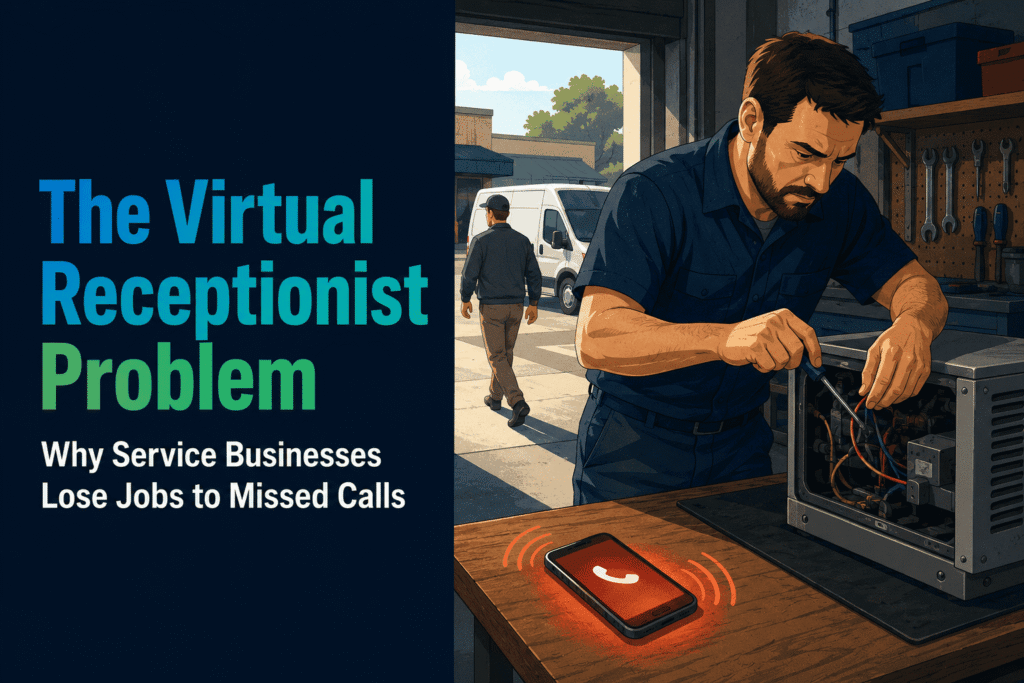
The Virtual Receptionist Problem: Why Every Service Business Loses the Same Jobs to Missed Calls
A missed call isn’t really a phone problem. It’s the same lost job, replaying across every trade — HVAC, plumbing, electrical, roofing, construction, personal injury law, healthcare, facility management. Here’s why “get a virtual receptionist” is the wrong fix, and what actually works instead.
Quick Answer
A virtual receptionist can catch a call. It can’t tell you why that call was worth catching, or what else in your business is quietly costing you more. RevUp Now AI isn’t a virtual receptionist company — we’re an AI operations partner. We look at your specific business first, then build the system it actually needs. Sometimes that includes call handling. Often it’s something else entirely: invoicing, scheduling, intake, collections, dispatch.
Who This Is For
Any service business where the person doing the work is also the person who’d answer the phone. HVAC and plumbing companies, electricians, roofers, general contractors, personal injury firms, medical practices, facility management teams — anywhere a missed call has ever turned into a missed job.
The scenario repeats everywhere
Every trade has the exact same “busy hands, ringing phone” moment — only the tools in those hands change.
The cost is identical too
One missed call is one job that just called the next name on the list. That’s true in every industry, every time.
“Get a receptionist” is the wrong question
The right question is “what’s actually costing us the most right now?” — and the answer is different for every business.
We build the system, not a feature
Call handling might be part of what we build for you. Or it might not be. That depends entirely on where your business is actually bleeding time and money.
The same phone call, every industry
Swap the job site and the story doesn’t change:
- The HVAC tech is elbow-deep in a condenser when a homeowner calls about a no-cool emergency.
- The electrician is mid-panel, hands full, when a new customer calls to ask about a quote.
- The plumber is under a sink when the phone buzzes with a burst-pipe call three streets over.
- The roofer is on a ladder after a storm when six calls come in back-to-back.
- The general contractor is walking a job site when a sub calls about a change order that needs an answer now.
- The personal injury firm’s intake line rings at 7 PM on a Friday, right when the caller is most likely to hire whoever answers first.
- The medical practice’s front desk is juggling three patients at the counter when the phone rings with a scheduling request.
- The facility manager is walking a building when a tenant calls in a work order that could’ve gone to any of six technicians.
Different trade, different tools, same exact moment: the work and the phone are competing for the same two hands, and the work wins. It has to. But every time it wins, something else quietly loses.
What a missed call actually costs
Most callers don’t leave a voicemail and wait patiently. They call the next name on the list — a competitor, a referral, whoever picks up. That’s true whether the “list” is a Google search results page or a stack of business cards passed around a job site. A single missed call isn’t a minor inconvenience; it’s a specific job, a specific invoice, a specific client, that simply went somewhere else.
Why “just add an AI receptionist” misses the point
Search around and you’ll find plenty of companies selling exactly that: an AI receptionist app, a virtual answering tool, a login and a setup wizard. Buy it, configure it, hope it fits your business. That’s a tool. It’s not a fix for your business specifically — it’s a fix for a generic version of every business that ever bought it.
We’re not an AI agency handing you a tool and a login. We’re an AI operations partner — we sit down with you first, find out where the real cost is actually hiding in your operation, and build a system around that. For one business, the answer is call handling. For another, it’s getting invoices out the same day instead of a week later. For another, it’s making sure a work order never gets sent to two technicians at once. The pain point that opens the conversation and the system we end up building are often two different things.
Virtual receptionist vs. AI operations partner
| Off-the-shelf AI receptionist | Generic answering service | RevUp Now AI | |
|---|---|---|---|
| What it starts with | A feature you sign up for | A phone line you route calls to | A conversation about where your business actually loses time and money |
| Who sets it up | You, in a dashboard | A vendor’s generic script | We do — built around your workflow, not a template |
| What it covers | Only call handling | Only call handling | Whatever your business actually needs — calls, booking, invoicing, dispatch, intake, or a combination |
| After you sign up | You’re on your own to configure and maintain it | Fixed script, rarely revisited | We implement it, manage it, and keep improving it every month |
| Pricing | Per-minute or per-seat subscription | Per-call or tiered plans | Flat monthly retainer, month-to-month, no lock-in |
How we figure out what to actually build
We sit down with you — not a committee — and map where calls, hours, and dollars actually leak out of your operation. Sometimes that’s the phone. Often it’s something nobody mentioned in the first conversation.
We build the specific system around what we find — your workflow, your tools, your trade. No generic template, no bolt-on app.
Go-live is supervised. We watch it run, tighten the rules in real time, and walk your team through exactly what changed.
We keep running it every month, and keep looking for the next bottleneck — because the first fix is rarely the only one.
Signs this is already costing you
- You’ve had a customer say “I called and nobody answered, so I went with someone else.”
- Your busiest hours for getting jobs are also your busiest hours for doing them.
- Calls that come in after hours or on weekends mostly go to voicemail — and mostly don’t get called back the same day.
- Nobody on your team can tell you, off the top of their head, how many calls you missed last week.
- You’ve thought about hiring someone just to answer the phone, and then thought about how much that person would cost sitting idle half the day.
Myths about AI operations partners
Myth: “This is just another AI tool.”
Reality: Tools get handed to you with a login. We build the system, run it, and stay on to manage and improve it — that’s what “operations partner” actually means.
Myth: “AI can’t be trusted with my customers.”
Reality: The system is built around how your specific business already talks to customers — not a generic script — and your team stays in the loop on anything that needs a human judgment call.
Myth: “This only works for tech-forward companies.”
Reality: Every business we’ve described in this article runs on phone calls, paperwork, and people remembering what needs to happen next — that’s exactly the kind of operation this is built for.
Myth: “I’d have to learn new software.”
Reality: Done-for-you means done for you. No dashboard to babysit, no prompts to manage.
Related reading
HVAC Dispatch-to-Invoice Automation →
Prior Authorization Automation for Medical Practices →
Not sure what your business actually needs first?
That’s exactly what the first conversation is for. We’ll look at how your business actually runs and tell you, honestly, where the real cost is hiding — whether that turns out to be missed calls or something else entirely.
FAQs
Is a virtual receptionist the same thing as an AI operations partner?
No. A virtual receptionist — human or AI — answers calls. An AI operations partner starts by figuring out whether calls are even your biggest problem, then builds and runs whatever system actually addresses it, call handling included if that’s where the cost is.
How much does this cost?
A flat monthly retainer, month-to-month, with no long-term lock-in. Pricing depends on what we end up building for your specific operation, not a per-minute or per-seat rate.
Can I use AI to answer calls for my business?
Yes — but the more useful question is whether call answering is actually your biggest bottleneck, or just the most visible one. We help you figure out which.
Is there a free AI answering service?
There are free, limited versions of basic AI answering tools. They handle the call. They don’t touch what happens to that lead afterward — the scheduling, the invoicing, the follow-up — which is usually where the bigger cost actually lives.
What if my business doesn’t need call handling at all?
Then we won’t build it. The consult comes first specifically so we’re not selling you a feature you don’t need — we build around what your business actually needs.
How do I know what to build first?
You don’t have to know going in. That’s what the first conversation is for — we map where your business actually loses time and money, and start there.