
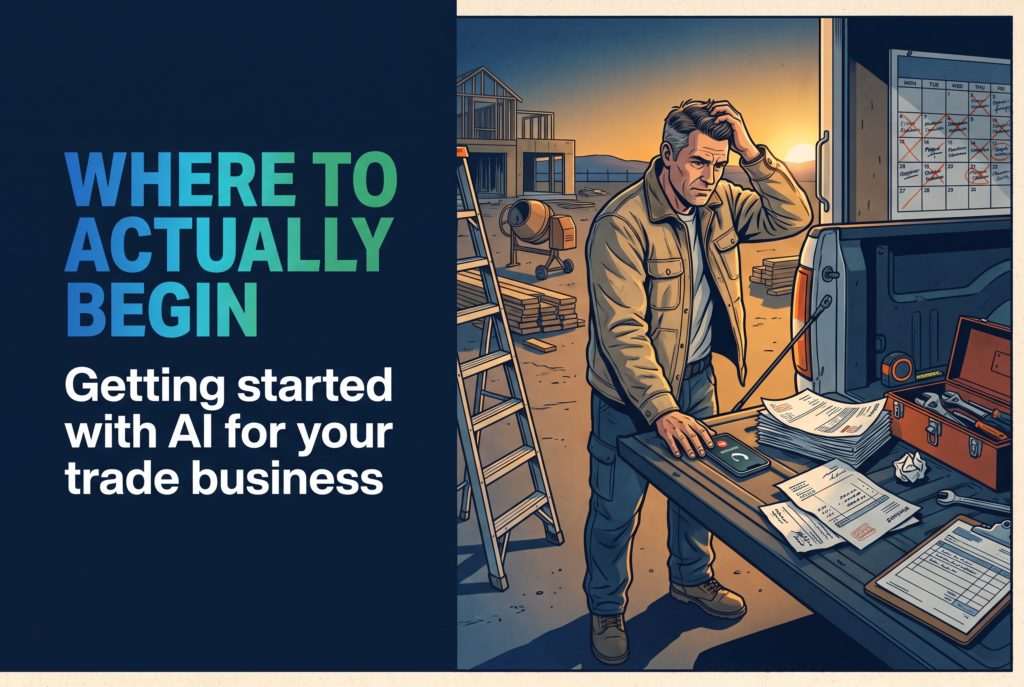
Getting Started with AI for Your Trade Business: Where Actually to Begin
Most contractors don’t have an “AI problem.” They have a bottleneck problem, and it’s been there since before AI was a marketing word. Before you buy anything, it helps to know exactly where your business is actually bleeding time — because that’s the only thing that tells you what to fix first.
Cross-Industry
7 min read
Quick Answer
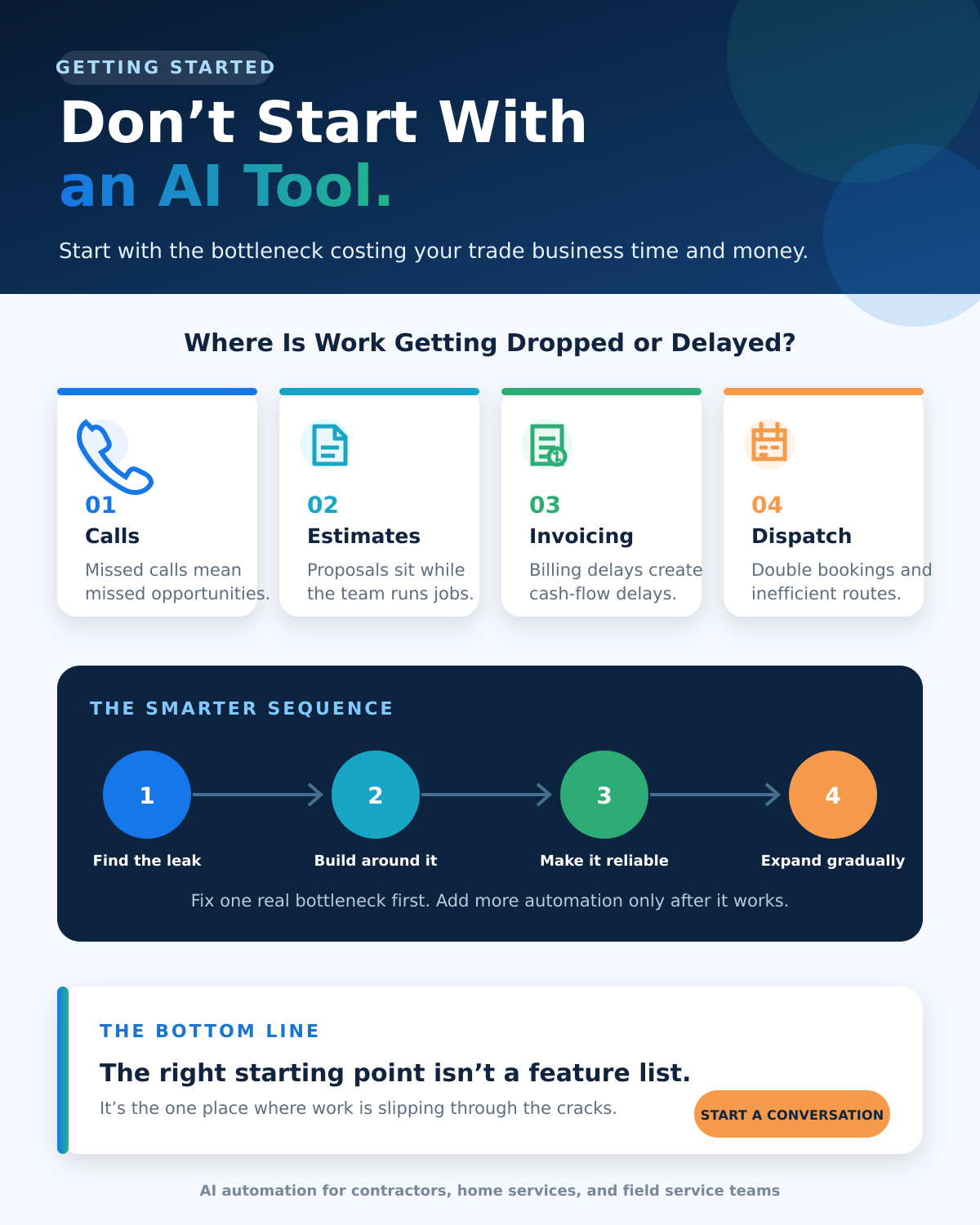
Don’t start by picking an AI tool. Start by finding the one place in your business — calls, estimates, invoicing, or dispatch — where work is actually getting dropped or delayed. Fix that bottleneck first with a build made for how your business runs, then expand from there.
Who This Is For
Owners of trade and service businesses (contractors, home services, field service companies) who know they need to modernize but haven’t adopted any automation yet, and don’t want to guess their way into another subscription that sits unused.
The Real Question Isn’t “Which AI Tool” — It’s “Which Bottleneck”
Type “AI for contractors” into a search bar and you’ll get a list of apps. A scheduling app. An estimating app. A texting app. Each one promises to fix a piece of the business, and each one asks you to create an account, learn the interface, and hope it talks to whatever software you’re already running.
That’s backward. The businesses that get real relief from automation didn’t start by shopping for software. They started by figuring out where the actual damage was happening — which calls went unanswered, which estimates sat in a truck for four days, which invoices never got sent because nobody had ten free minutes. Once you know that, the right fix is obvious. Before you know that, every tool looks equally appealing and equally risky.
The Four Places Trade Businesses Actually Lose Time
Almost every contractor we talk to is losing time in one (or more) of the same four places. Here’s how to tell which one is yours.
Missed calls after hours, during job site work, or when the phone rings while someone’s on a ladder. Every missed call is a competitor’s answered one.
Site visit happens, then the estimate sits for days because writing it up competes with actually running jobs.
Jobs finish, but billing lags behind the work by a week or more, which means cash lags behind the work, too.
Techs double-booked, routes crossing town twice in a day, and the schedule living in someone’s head instead of a system.
Most owners can name their worst one in under ten seconds when asked directly. That answer is worth more than any feature list.
Why Most Contractors Start With a Tool and End With a Mess
This isn’t a failure of any one tool. It’s a failure of sequencing. DIY subscriptions ask you to be your own systems integrator while running a trade business. That’s a lot to ask of someone whose actual job is roofs, pipes, panels, or HVAC units — not software administration.
What Starting With a Consult Actually Looks Like
The alternative isn’t “more tools.” It starts with a conversation about your actual bottleneck, then builds around it — instead of buying a shelf of software and hoping it fits.
| Question | DIY Tool Subscription | Done-for-You Build (RevUp Now AI) |
|---|---|---|
| Where do you start? | You can pick a tool from a review site and hope it fits your workflow. | A consult to find your actual bottleneck first |
| Who sets it up? | You, in whatever time is left after running jobs | Built and configured for you around how your business already operates |
| What happens when it doesn’t fit? | You troubleshoot alone or start shopping again | It gets adjusted as part of an ongoing relationship, not a one-time purchase |
| How many logins does it add? | Usually one more per problem you’re solving | Built to work with what you already use, not stacked on top of it |
| Who’s accountable if it breaks? | The software vendor’s support queue | The team that built it, because they’re maintaining it |
What the First 30 Days Actually Look Like
This is deliberately narrow at the start. A business that’s never automated anything doesn’t need five systems running simultaneously in month one. It needs the one that stops the bleeding, working reliably, before anything else gets added.
Myths About Getting Started
Myth: “This is just another AI tool”
Tools ask you to log in and operate them. This is a build made around your specific bottleneck, maintained by the people who built it — not a dashboard added to your existing pile.
Myth: “I need to understand AI before I start”
You don’t need to know how any of it works under the hood. You need to know where your business is losing time — that’s the only technical knowledge required to start.
Myth: “It’ll take months before I see anything”
Starting narrow on one real bottleneck means the first fix is usually live and working long before a five-tool DIY stack would even be fully connected.
Myth: “I’ll get locked into something I don’t understand”
A consult-first approach means nothing gets built until the actual problem is identified together — there’s no guessing, no generic package, and no black box.
Related RevUp Now AI Resources
AI for HVAC Companies
AI for Plumbing Companies
AI for Electrical Contractors
AI for Construction Firms
AI Intake FAQ
Not Sure Which Bottleneck Is Costing You the Most?
That’s exactly what the first conversation is for. Tell us how calls, estimates, invoicing, or dispatch actually work in your business today, and we’ll help you figure out where to start.
Frequently Asked Questions
Do I need to already use other software before this will work?
No. A build is designed to work with whatever you’re already using, whether that’s a paper system, a spreadsheet, or existing software. The starting point is your workflow, not a specific tech stack.
What if I don’t know which bottleneck is worst?
Most owners can identify it in a short conversation once someone asks the right questions — that’s part of what the first consult is for. You don’t need to diagnose it alone beforehand.
Is this only for large trade businesses?
No. Solo operators and small crews are often losing the most time relative to their size, since there’s no office staff to absorb the missed calls or delayed paperwork.
How is this different from hiring an office manager?
An office manager handles tasks manually during business hours. A build like this can answer calls, follow up on estimates, or send invoices around the clock, without adding a full-time salary.
What happens after the first bottleneck is fixed?
The relationship continues — the next-worst bottleneck gets addressed once the first one is solid, so the business grows into more automation instead of being handed all of it at once.