

What Does AI Automation Actually Cost for a Small Contractor?
Ask five vendors what an AI build costs and you’ll get five different answers, none of them useful. Here’s what actually drives the number, and why “how much does this cost” is the wrong first question.
Quick Answer
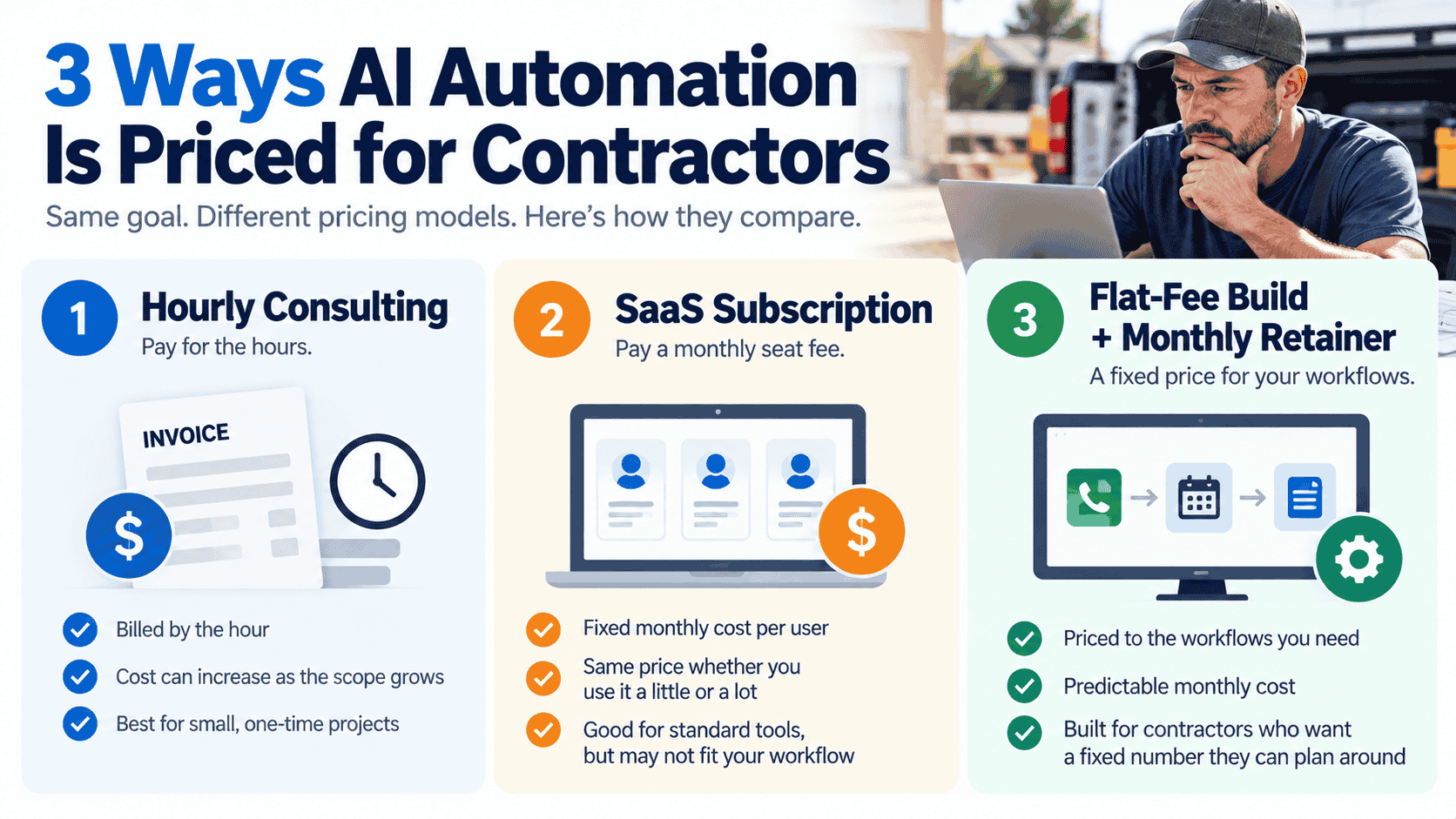
There’s no single flat number, because the honest answer depends on scope, not a price list. What you can compare are the three pricing models on the market: hourly consulting (billed by the hour, no cap), generic SaaS subscriptions (a monthly seat fee regardless of how much you use it), and a flat-fee build with a flat monthly retainer (priced to the workflows you actually need, not the hours it takes or the seats you buy). The retainer model is the one built for contractors who want a fixed number they can plan around.
Who This Is For
Small and mid-sized contractors, plumbing, HVAC, electrical, roofing, general, who’ve started pricing out automation, gotten three different quotes with three different structures, and want to understand what’s actually driving the gap before they sign anything.
Why There’s No Single Answer
Every contractor who calls around for AI automation pricing runs into the same wall: nobody quotes the same way. One vendor quotes an hourly consulting rate. Another quotes a per-seat SaaS subscription. A third quotes a flat project fee plus a monthly number. They’re not hiding the ball, they’re selling fundamentally different things, and the pricing structure tells you more about what you’re buying than the number does.
A $300/month SaaS subscription and a $3,000 flat-fee build aren’t competing offers for the same job. One rents you software you configure yourself. The other builds and runs the actual workflow, the call handling, the follow-up, the routing, around your business specifically. Comparing the sticker price without comparing what’s actually included is how contractors end up either overpaying for a DIY tool they never fully set up, or underpaying for consulting hours that evaporate before the work is finished.
The Three Pricing Models You’ll Run Into
Strip away the marketing and every quote you get falls into one of three structures. Here’s how they actually compare on the things that matter to a contractor deciding where to spend money.
| Model | How it’s priced | What you’re actually buying | Where it breaks down |
|---|---|---|---|
| Hourly consulting | Billed per hour, open-ended | Someone’s time and expertise, no fixed endpoint | Scope creep, the clock doesn’t stop when the workflow does |
| Generic SaaS subscription | Flat monthly fee per seat or tier | Software you configure, maintain, and troubleshoot yourself | The subscription is cheap; the setup and upkeep time isn’t |
| Flat-fee build + retainer | One build fee, then a flat monthly amount | A working system built around your business, running and maintained for you | Higher entry point than a subscription tier, you’re paying for done-for-you, not DIY |
None of these is automatically the “right” one. A contractor who genuinely enjoys tinkering with software and has the spare hours might do fine with a subscription tool. Most don’t have those spare hours, that’s the entire reason they’re pricing out automation in the first place.
What Actually Drives the Price on a Done-for-You Build
For a flat-fee build, three things move the number, and none of them is “which package tier you pick” the way a SaaS pricing page works.
How many separate problems are you asking it to solve, just missed calls, or missed calls plus estimate follow-up plus invoice collections?
A plumbing dispatch workflow and a personal injury intake workflow use different logic, different integrations, and different compliance considerations.
One automated workflow costs less to build and maintain than five connected ones that hand off to each other.
A build that has to connect to your current CRM, phone system, or accounting software takes more work than one built from scratch.
This is why a legitimate quote asks about your business before it gives you a number. A vendor who quotes a flat price before understanding what you actually need is either padding the number to cover unknowns, or about to under-scope the build and hit you with change orders later. Neither is a good sign.
AI Receptionist Pricing, Specifically
Voice-agent pricing gets asked about separately from the rest of the build because it’s the piece most contractors shop first, it’s the most visible problem (the missed call) and the easiest to compare across vendors on paper.
The same three-model split applies. A generic AI receptionist subscription usually bills per minute of call handling or per seat, on top of a base monthly fee, with usage caps that can spike your bill in a busy month. A flat-fee build folds the receptionist into the monthly retainer at a predictable number, because it’s priced to your call volume and what happens after the call, not billed per minute like a metered utility.
The question worth asking any receptionist vendor isn’t “what’s the monthly fee”, it’s “what happens to the call after it’s answered.” A tool that answers the phone and stops there is solving a third of the problem. A quote that includes routing, booking, and follow-up is solving the whole thing, and that’s usually where the price difference actually comes from.
Questions to Ask Before You Sign Anything
A pricing conversation that’s worth trusting will hold up under a few direct questions. One that dodges them is telling you something.
- What exactly is included in the flat fee, and what triggers an extra charge?
- Who maintains the workflow after launch, is that included in the retainer, or billed separately?
- What happens if my call volume or job volume doubles, does the price change, and how?
- Can I see what this looks like for a business similar to mine, without fabricated numbers?
The Myths Getting in the Way
“AI automation is only for large companies with big budgets.”
The pricing models exist specifically because small contractors need a predictable number, not an enterprise contract. Scope is what changes, not eligibility.
“It’s just another subscription I’ll forget to use.”
That’s a real risk with self-serve SaaS tools. A done-for-you build is built and run for you, so there’s no dashboard sitting unused.
“If it’s not a fixed price on a website, it’s a scam.”
A single fixed price on a page means every business gets the same build regardless of size or need, which usually means it’s underbuilt for bigger operations and overpriced for smaller ones.
“Cheaper is always the safer choice.”
The cheapest quote is often the one where you do the setup, maintenance, and troubleshooting yourself, on top of your own workload.
Get a Real Number for Your Business
The only way to know what this actually costs you is to talk through your scope, your call volume, and what’s currently falling through the cracks. RevUp Now AI starts every build with that conversation before any number gets attached to it.
Talk Through Your ScopeFrequently Asked Questions
Does RevUp Now AI publish a fixed price?
No, and that’s deliberate. A single published price would mean a one-person plumbing outfit and a 40-person electrical company get the same build, which doesn’t serve either of them well. Pricing is set after a scope conversation, based on your call volume, the number of workflows you need, and your vertical.
Is a flat-fee build always more expensive than a SaaS subscription?
Not necessarily, once you count your own setup and maintenance time. A subscription’s sticker price is usually lower, but you’re the one configuring, updating, and troubleshooting it. A flat-fee retainer folds that labor into the monthly number.
What’s included in a monthly retainer versus billed as an extra?
This varies by vendor, which is exactly why it’s the first question to ask. Ongoing maintenance, monitoring, and small adjustments should be part of the retainer, a legitimate quote will spell out where the line is before you sign anything.
Does AI receptionist pricing work differently from the rest of the build?
Some vendors price it separately, often per minute or per call, which can spike unpredictably in a busy month. A flat-fee build typically folds receptionist handling into the same predictable retainer as the rest of the workflow.
How do I know if a quote is under-scoping the work?
If a vendor gives you a number before asking about your call volume, your current systems, and what happens after a call or estimate goes out, the quote is a guess. Expect change orders later if you accept it.