

How Much Does an Answering Service Cost? Why the Billing Model Matters More Than the Price
The honest answer to “how much does an answering service cost” is that the price per month matters less than how the service bills you. Two services with the same sticker price can produce very different invoices once a busy week hits. For a trade business, where call volume swings with the weather, the billing model is the real cost.
Quick Answer
An answering service’s monthly price matters less than how it bills you. Per-minute plans rise in the weeks you are busiest, bundled plans add overage once you pass the allowance, and a flat monthly fee stays the same through a surge. Compare the billing model and what the caller walks away with, not just the sticker price.
Who This Is For
Owners and office managers at HVAC, plumbing, electrical, roofing, and other trade businesses who are comparing answering services and want to know what the invoice will look like in a busy month, not just the quoted rate.
Below are the three common models, what drives each one up, and the questions worth asking before you sign anything.
The three common billing models
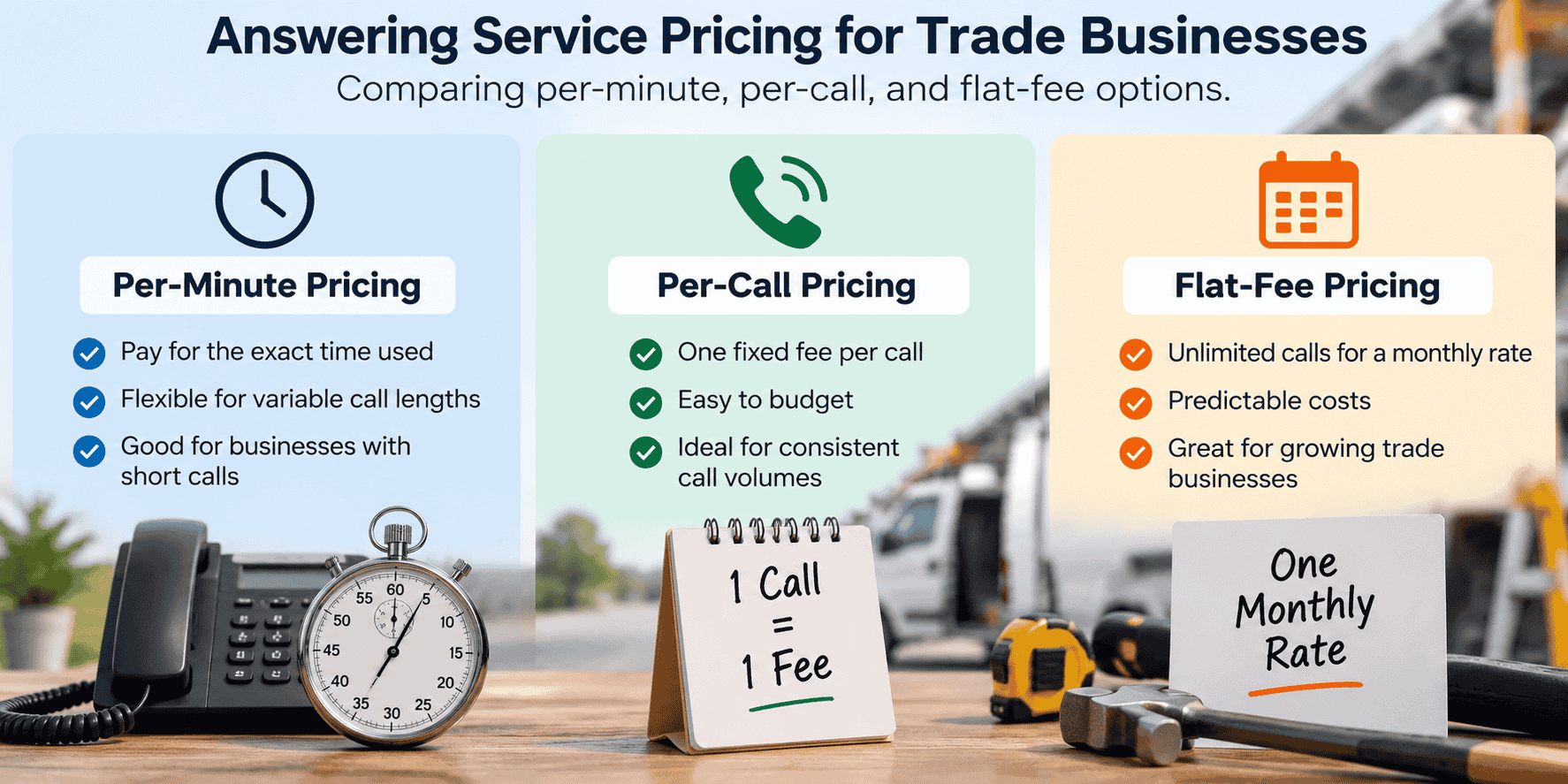
Per-minute billing
You pay for every minute an operator or system spends on a call. It looks cheap when you picture a short call. It stops looking cheap when an HVAC customer talks through a symptom for six minutes, or when a heat wave doubles your call volume. Your bill rises in exactly the weeks you are busiest.
Per-call or bundled plans
You get a set number of calls or minutes for a monthly price, then pay overage once you pass it. This is more predictable than pure per-minute billing, but only if the bundle fits your real volume. Ask what counts as a call. Spam calls, wrong numbers and callbacks are billed as calls at some services.
Flat monthly fee
One monthly price regardless of volume. You can budget it, and a surge in calls does not change the invoice. The tradeoff is that flat-fee providers usually charge a setup or build fee up front, because the system is configured to your shop rather than shared across a call center script.
| Billing model | What you pay for | What pushes it up | Where it fits |
|---|---|---|---|
| Per-minute | Every minute on a call | Long calls and busy weeks | Very low, steady volume |
| Per-call or bundled | A set number of calls or minutes, then overage | Passing the allowance, and what the service counts as a call | Volume that stays inside the bundle |
| Flat monthly fee | One price regardless of volume | Nothing in a surge, but expect a setup or build fee up front | Seasonal or unpredictable volume |
Prefer to skip the per-minute math? See our virtual receptionist or an AI appointment setter.
What actually drives the price up
Whatever the model, a few things push the total higher than the quote suggested:
- Call length. Technical trades have longer calls than a pizza order. Per-minute plans punish that.
- Seasonality. Summer for HVAC, storm weeks for roofing, a cold snap for plumbing. Volume spikes are the norm, not the exception.
- Overage rules. Read what happens after the included minutes run out.
- Add-ons. Appointment booking, calendar integration, text follow-up and emergency dispatch are priced separately at some services.
- Contract terms. Annual lock-ins turn a mistake in picking a provider into a year-long one.
The cost nobody puts on the quote: the call you missed
Picture a July afternoon when a customer’s AC quits. They work down the Google results until a company picks up and offers a window. A voicemail box, or a service that promises a morning callback, lets that job slide to whoever answered. That is why a price comparison should include what the caller leaves the call with. A message taken and a booked appointment are different products, even at the same monthly price.
Questions to ask before you sign
- How exactly am I billed: per minute, per call, or flat? What counts as a billable call?
- What happens to my bill in my busiest month?
- Does it book into my real schedule, or just take a message?
- What happens on a true emergency at 2am, and who gets notified?
- Is there a setup fee, and is there a contract term?
- Can I leave month to month?
How RevUp Now AI prices it
RevUp Now AI works on two flat charges: a one-time build fee to configure the system around your shop, then a monthly fee to run and maintain it. Nothing is metered by the minute, so a heat wave doesn’t change the invoice. There’s no contract lock-in, and the first task typically goes live in about 30 days. You can see the full breakdown on our HVAC answering service page, or read how the first 30 days go.
Related RevUp Now AI Resources
Want to See What a Flat-Fee Setup Would Look Like for Your Shop?
Bring your busiest month’s call count and we’ll show you what the numbers look like with no per-minute billing.
Book a CallAnswering service cost FAQ
Is a flat-fee answering service better than per-minute?
For businesses with seasonal or unpredictable call volume, usually yes, because the bill does not rise when you are busiest. Per-minute can be cheaper for very low, steady volume.
Why do some answering services charge a setup fee?
Setup covers writing your call scripts, connecting your calendar or scheduling tool, and defining emergency rules. Services that configure the system to your business tend to charge for it up front.
What is the difference between an answering service and an AI answering service?
A traditional service uses live operators who mostly take messages. An AI answering service uses software to hold the call and complete the task, such as booking the appointment.