

Personal Injury Speed to Lead: What Happens in the First Five Minutes After Someone Calls
A new lead calls after an accident, and the firm that picks up first usually signs the case, what marketing teams call speed to lead. Here’s what actually needs to happen in that first five minutes. And here’s how AI can handle the repetitive parts, without replacing the judgment call of an intake specialist.
Speed to Lead
Personal Injury Law
Quick Answer
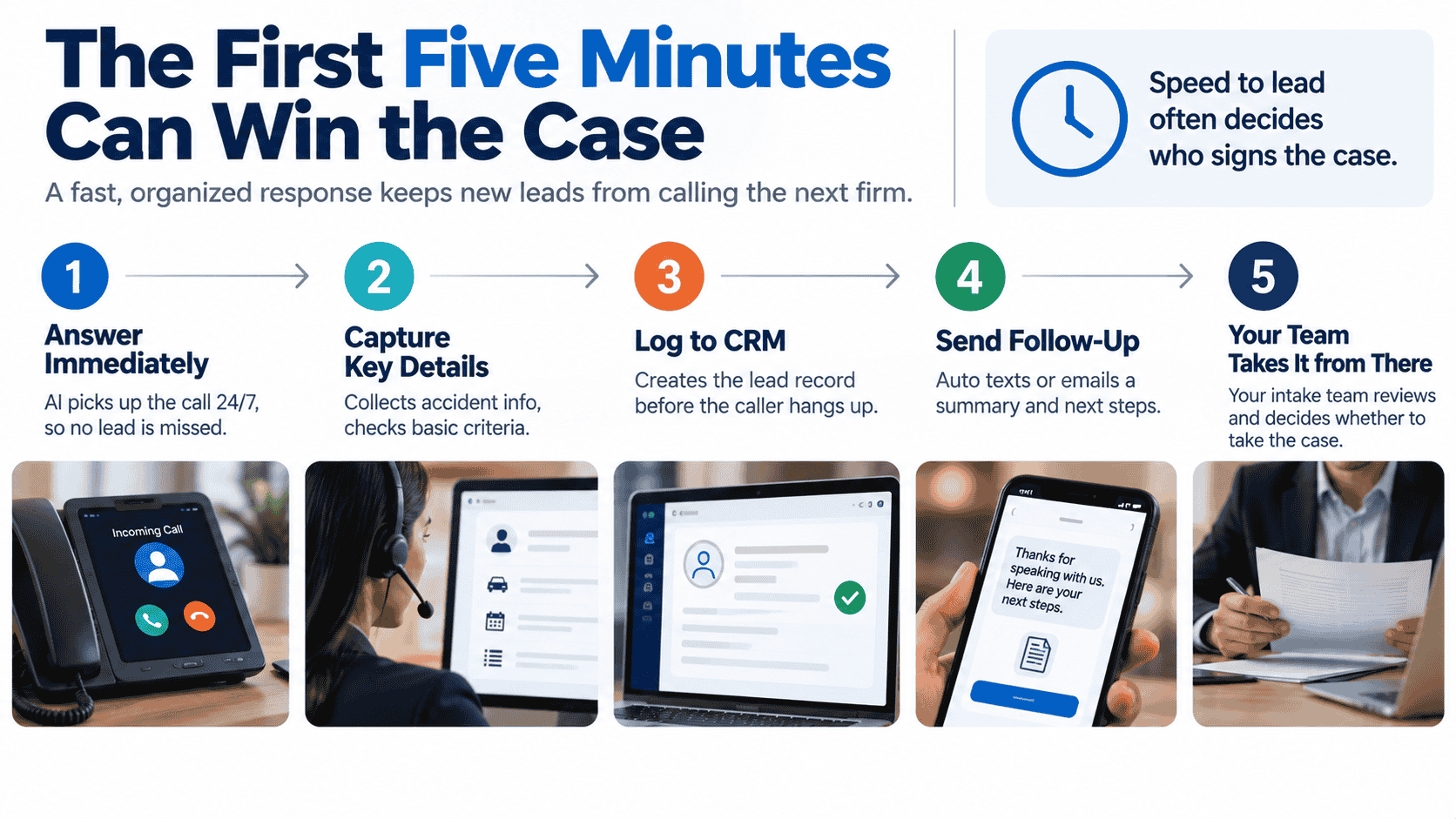
Personal injury speed to lead is how fast a firm responds to a new call, and it’s the single biggest factor in who signs the case. Legal intake automation uses AI to answer a call immediately, capture the facts of the accident, and screen against a firm’s baseline case criteria. It logs the lead into the CRM before the caller hangs up and tries the next firm. It does not decide whether to take a case. That stays with your intake team.
Who This Guide Is For
- Personal injury attorneys and firm owners
- Intake and case management teams
- Marketing directors buying PI leads
- Firms evaluating AI for phone coverage
Key Takeaways
Whoever answers first and follows up fastest usually wins the client, not necessarily the best firm.
Capturing accident details, checking baseline criteria, and logging the lead can happen immediately, day or night.
Whether to take a case and how to talk with someone who just had an accident stay with your intake team.
The same system can handle follow-up reminders and document requests so cases do not go cold waiting on paperwork.
A car accident happens on a Friday evening. By the time the person calls a law firm, it’s already 7 PM. If that call goes to voicemail, they call the next name on the list. Then the next. Until someone actually picks up.
This guide covers what needs to happen in those first five minutes to keep that caller from becoming someone else’s client. It also covers what still needs a real person, and how a managed AI system handles the repetitive parts of intake.
Related: our law firm CRM setup and lead follow-up automation.
What Actually Needs to Happen in the First Five Minutes
The first five minutes after someone calls about a potential case are not about closing them. They are about capturing enough to know if there’s a case worth pursuing. And they’re about making the caller feel like someone is actually paying attention.
Done well, those five minutes should:
- Answer the call, every time, regardless of the hour.
- Get the basic facts: what happened, when, where, and who was involved.
- Screen against the firm’s baseline criteria for injury type, timing, and fault.
- Capture contact information and consent to follow up.
- Flag anything urgent, like ongoing medical treatment or an approaching deadline, for immediate human attention.
Why the Friday-Night Call Is the Real Test
Most firms can handle a call that comes in at 10 AM on a Tuesday. The real test is the one that comes in at 7 PM on a Friday, or 2 AM on a Sunday. Nobody’s at the office, and the caller is deciding between one firm and whichever one answers next.
That caller does not wait. If a firm does not pick up, they move to the next search result or the next name a friend gave them. The firm that signs the case is often not the best firm. It is the one that answered.
What Stays Human
- Deciding whether to take a case
- Negotiating retainer terms
- Talking through the details of someone’s accident or injury with empathy
- Any call where the person is upset, in pain, or in crisis
- Judgment calls on borderline case viability
Legal intake automation should begin with clear scoping of what the system can and cannot decide on its own. That includes defining a firm’s non-negotiable case criteria before automating any part of the call.
Manual Intake vs. AI-Assisted Intake
| Intake Step | Manual Process | AI-Assisted Process |
|---|---|---|
| Answering the call | Staff, when available | Answered immediately, every time |
| Capturing case details | Handwritten notes or memory | Structured intake captured every time |
| After-hours calls | Voicemail or a general answering service | Live intake continues nights and weekends |
| Screening | Whoever answers decides in the moment | Consistent baseline screening, human review for edge cases |
| Follow-up | Depends on staff bandwidth | Reminders keep leads warm automatically |
Beyond the First Call
Intake does not end after the first five minutes. Personal injury cases often stall while waiting on medical records, a signed retainer agreement, or a callback the client never got. The same system that handles the first call can also handle reminders, document requests, and status updates. That way, a case doesn’t go cold because nobody followed up.
This is one example of what personal injury law AI agents can be built to do. The actual scope depends on where a specific firm’s intake process is actually breaking down. For the fuller picture, including how this connects to CasePeer, Litify, MyCase, and the other case management platforms firms already run, see Personal Injury Intake Automation: What Case Management Software Doesn’t Fix.
How RevUp Now AI Builds the System
Consult
Map the current intake process and define the case criteria that decide what moves forward.
Build
Customize the system around the firm’s practice areas, case criteria, and CRM.
Implement
Launch under supervision, often starting with after-hours coverage, then expand after review.
Maintain
Monitor call quality, adjust screening criteria, and keep the system current as the practice changes.
Learn more about the broader RevUp Now AI process and how managed automation differs from self-serve intake software.
Common Myths About Legal Intake Automation
Myth: AI decides whether to take a case
Intake staff make that call. The system’s job is to get them a complete, qualified lead.
Myth: Callers can tell and hang up
Built well, the system focuses on capturing facts accurately, not pretending to be something it is not.
Myth: This only works for high-volume firms
Even one missed call after hours is a lead that went to a competitor.
Myth: It replaces the intake team
It removes the repetitive parts so the team spends time on cases, not voicemail catch-up.
Related RevUp Now AI Resources
Ready to Stop Losing Cases to a Missed Call?
See how RevUp Now AI can help your firm capture every call, screen for viability, and keep cases moving after the first five minutes.
Frequently Asked Questions
What is legal intake automation?
It’s an AI-assisted workflow that answers calls immediately, captures accident details, and screens against a firm’s baseline case criteria. It then logs qualified leads into the CRM. It does not decide whether to take a case.
Can AI actually screen personal injury cases?
It can check baseline criteria a firm sets, such as injury type, timing, and jurisdiction. The decision to take a case stays with the intake team.
What happens to calls outside business hours?
The system answers them immediately instead of sending them to voicemail, so the caller doesn’t move on to the next firm.
Does this replace intake specialists?
No. It handles the repetitive first-contact work so specialists spend their time on cases that are already qualified and documented.
How is this different from a legal answering service?
An answering service mainly takes messages. This system captures structured case details, screens against a firm’s criteria, and keeps the lead moving with follow-up. That’s different from a message left for someone to call back.
What happens to a call that does not fit clean criteria?
It routes to a person instead of getting marked as unqualified automatically.