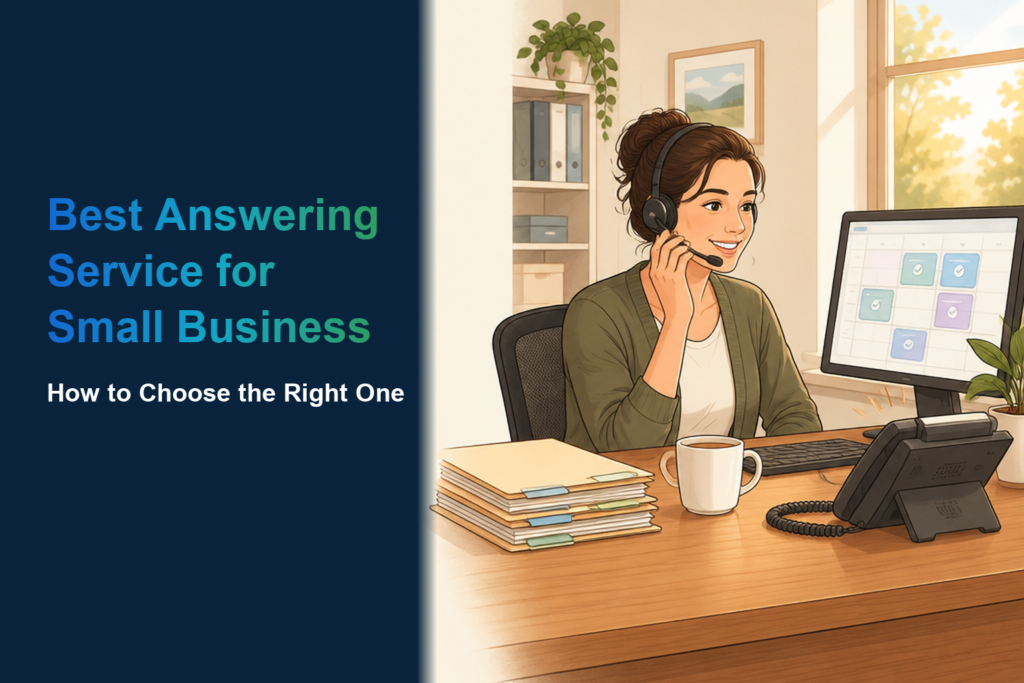
Best Answering Service for Small Business (2026 Guide)
If you run a small service business, you have probably asked which answering service to use. The honest answer depends on what is actually costing you. A live service, a virtual receptionist and an AI answering system each solve a different part of the problem, and the cheapest option is not always the one that books the most jobs.
Quick Answer
The best answering service for a small business is the one that matches your problem. A live service handles overflow and after-hours message-taking, a virtual receptionist fits if you need a human voice that books appointments, and an AI answering system fits if calls arrive all day while your team is on jobs. Compare what the caller walks away with, not just the monthly price.
Who This Is For
Owners and office managers at plumbing, HVAC, electrical, roofing, legal, and other small service businesses who are comparing answering services and want to know which model will actually book work.
The three main options
Live answering services
A call center staffed by people who answer on your behalf, usually from a script, and take a message or pass the call along. They handle tone well and can cover nights and weekends. The trade-off is that they can only do what the script allows, and pricing usually scales with minutes or calls. They take a message well, but they rarely book straight into your calendar.
Virtual receptionists
A person or small team that answers as your front desk, often with access to your calendar and a set of rules you give them. This is closer to a real receptionist than a message-taker. The quality depends on how clear your rules are and how stable the provider’s staff is. If booking is the goal, see our virtual receptionist for service businesses.
AI answering systems
An AI receptionist answers every call, asks the questions you would ask, books into your calendar and hands off anything it cannot handle. It is available 24/7, so a call at night or during a storm gets the same treatment as a call at noon. It only works as well as the setup behind it: your services, your pricing rules, your service area, and a clear list of what goes to a person. Learn more on our AI answering service page.
Which one fits your business
Use this as a rough guide:
- Mostly after-hours overflow and low call volume: a live service can cover nights and weekends without a full-time hire. See our after-hours answering service.
- You need booking and a human voice: a virtual receptionist with calendar access is a good fit.
- Calls come in all day while your team is on jobs: an AI answering system covers every call without a queue.
- Calls are only part of the problem: if estimates, follow-ups and invoices are also slipping, answering is one step in a longer process. That is where AI workflow automation earns its keep.
Side-by-side comparison
| Option | Best at | Usually weak at | Good fit when |
|---|---|---|---|
| Live answering service | Taking messages after hours | Booking into your calendar | Overflow and nights and weekends |
| Virtual receptionist | Human tone and booking with clear rules | Consistency when staff changes | You want a front desk voice |
| AI answering system | Every call, all day, with instant booking | Needs a solid setup and clear handoff rules | High call volume while your team is on jobs |
Questions to ask any provider
- What happens on a call, step by step? Ask for a sample call recording or a live demo.
- Where does the caller’s information go, and how do I get it?
- Does it book directly on my calendar, or does someone have to copy the appointment over?
- What triggers a handoff to a person, and who is that person?
- How is it priced: per minute, per call, or a flat monthly fee? What happens when my call volume spikes? See our breakdown of how much an answering service costs.
- How long until it is live, and who maintains the setup when my services or prices change?
Answering services by trade
The right setup depends on the work you do. Each of these pages covers the call types, emergencies and booking rules specific to that trade.
After hours and field service follow-up
Answering the call is the first step. What happens next decides whether the job gets booked. A caller who reaches voicemail at 9 pm usually calls the next company on the list in the morning, so the answering setup should do more than take a message.
Once the call is answered, the follow-through matters most: a dispatch that goes out on time, an estimate that gets sent while the customer is still interested, and an invoice that gets chased before it goes stale. Our field service automation work covers that stretch from dispatch to payment, and our HVAC dispatch-to-invoice and plumbing collections guides show how those steps fit together.
How RevUp Now AI approaches it
We build AI answering as part of the job, not as a separate phone app. The answering setup connects to your schedule, your follow-up sequence and your CRM, so a booked call becomes a confirmed appointment and a missed call gets a text back. Pricing is a one-time build fee plus a flat monthly fee, with no per-minute billing. Most setups go live in about 30 days. You can see how the work is scoped on our process page, or compare our approach to a plug-in AI receptionist in RevUp Now AI vs. Smith.ai. For the wider picture of automating your back office, start with the business automation guide.
Want to see what a setup would look like for your shop?
Bring your busiest week’s call count and we’ll walk through what the answering setup would handle, and what would still go to your team.
Book a CallWhere to go next
Best answering service FAQ
What is the best answering service for a small business?
There is no single winner. Live services suit overflow and after-hours messages, virtual receptionists suit businesses that want a human who books, and AI answering suits businesses with constant call volume. Match the model to the problem you are solving.
Is an AI answering service better than a live answering service?
For booking and all-day coverage, usually yes, because the AI answers every call at once and can book directly. A live service still makes sense when callers need a human voice for every call, and the AI should hand those off.
Do I need a virtual receptionist if I already have voicemail?
Voicemail is where calls go to die. Most callers who reach it call the next company on the list. A virtual receptionist or AI system answers in real time and can capture the job while the caller is still ready to book.